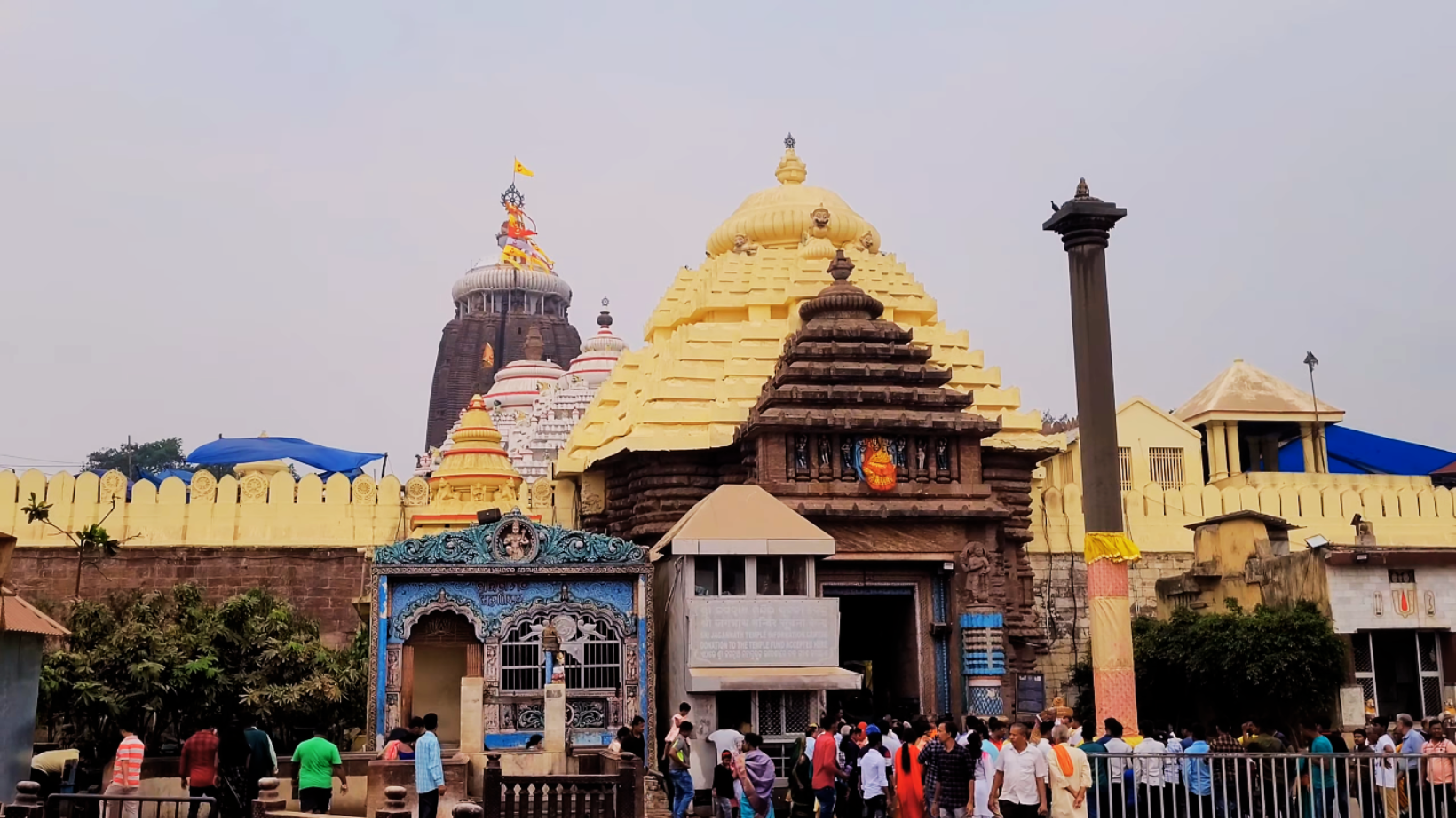
The Puri Jagannath Temple, one of the holiest pilgrimage sites in India, is a beacon of spiritual and cultural heritage. Located in the coastal town of Puri, Odisha, this 12th-century temple is dedicated to Lord Jagannath, an incarnation of Lord Vishnu, along with his siblings, Lord Balabhadra and Goddess Subhadra. Among the many sacred elements of this revered temple, the Ratna Bhandar, the temple’s treasury, stands out as a repository of immense historical, spiritual, and material significance. Known as the Ratna Bhandar Puri Jagannath Temple, this sacred vault has captured the imagination of devotees, historians, and archaeologists alike for centuries due to its vast collection of precious jewels, ornaments, and artifacts.
Explore the history, myths, and facts surrounding the Ratna Bhandar, delving into its origins, contents, controversies, and recent developments, including its reopening after 46 years in 2024.
Historical Significance of the Ratna Bhandar
The Ratna Bhandar Puri is not merely a storehouse of wealth but a symbol of devotion, faith, and the rich legacy of the Jagannath Temple. The treasury, located on the northern side of the Jagamohana (assembly hall) within the temple complex, is divided into two chambers: the Bahara Bhandar (outer chamber) and the Bhitar Bhandar (inner chamber). These chambers house the priceless jewelry and ornaments of Lord Jagannath, Lord Balabhadra, and Goddess Subhadra, donated by kings, devotees, and patrons over centuries.
The origins of the Ratna Bhandar Puri Jagannath Temple can be traced back to the temple’s construction in the 12th century by King Ananta Varman Chodaganga Deva of the Ganga Dynasty. The temple, often referred to as the “White Pagoda,” is one of the four sacred Char Dham pilgrimage sites for Hindus. The Ratna Bhandar evolved as a repository for offerings made to the deities, reflecting the prosperity and devotion of the rulers and devotees who contributed to it. According to legend, King Anangabhima Dev (1211–1238) donated 2.5 lakh madhas of gold to craft jewelry for the deities, laying the foundation for the treasury’s immense wealth.
The first detailed account of the Ratna Bhandar was documented in 1805 by Charles Grome, the then Collector of Puri, during British rule. His “Report on the Temple of Jagannath” listed 64 gold and silver ornaments, 128 gold coins, 1,297 silver coins, 106 copper coins, and 1,333 types of clothes. This report, preserved in the Puri collectorate’s record room, provides a glimpse into the treasury’s contents during the early 19th century. Subsequent inventories in 1926 and 1952, under the Shri Jagannath Temple Administration Act, further detailed the growing collection, which included 150 gold ornaments in the Bahara Bhandar and 180 types of ornaments in the Bhitar Bhandar, some weighing over 1.2 kg each.
The Ratna Bhandar is managed by the Shree Jagannath Temple Managing Committee, established under the Shri Jagannath Temple Act of 1952. The Act stipulates that the treasury’s contents are categorized into three types: Category I (never-used ornaments stored in the Bhitar Bhandar), Category II (ornaments used during ceremonial occasions), and Category III (ornaments for daily use, stored in the Bahara Bhandar). The Bhitar Bhandar, sealed under double lock and deposited in the government treasury, is opened only under special orders from the state government, making it a highly restricted and sacred space.
The Reopening of the Ratna Bhandar in 2024
On July 14, 2024, the sacred Ratna Bhandar of Puri Jagannath Temple was reopened after 46 years under the supervision of a high-level committee chaired by Justice Biswanath Rath. The Odisha government approved the reopening – a key promise in 2024.
The inspection began at 1:28 p.m., with rituals performed by the 11-member team including SJTA chief Arabinda Padhee, ASI officials, and Gajapati Maharaja Dibyasingha Deb. When the inner chamber (Bhitar Bhandar) couldn’t be opened with the old keys, locks were broken to gain access.
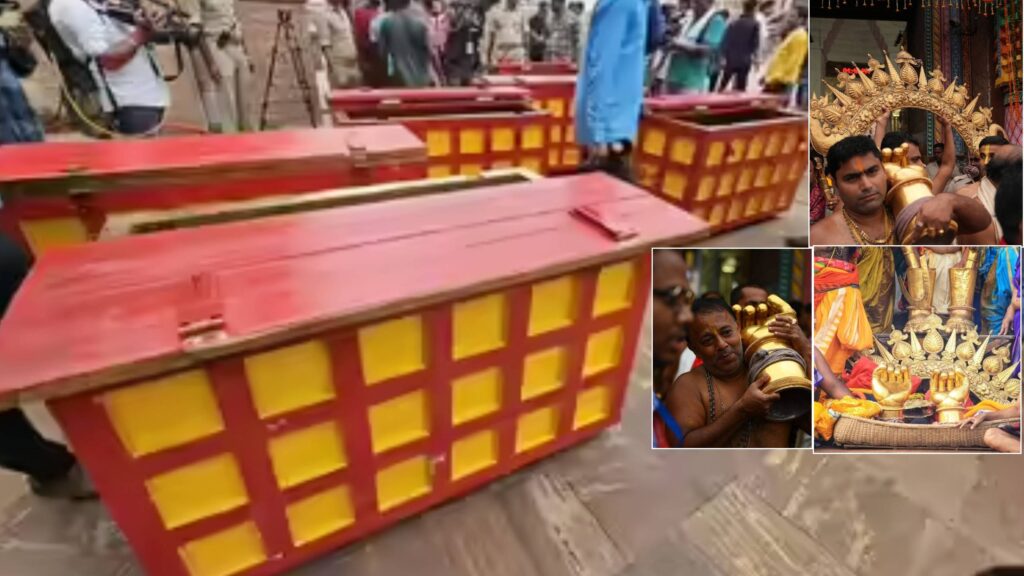
Initial inspection revealed wooden chests, almirahs, and scattered items. Due to time constraints and the Bahuda Yatra, the valuables were shifted to a secure strongroom on July 18, and the entire process was videographed for digital records. No snakes were found, busting long-held myths.
The event was deeply symbolic – religious, cultural, and political especially after the 2018 controversy over the “missing keys”.
Contents of the Ratna Bhandar
The Ratna Bhandar Puri Jagannath Temple is renowned for its vast collection of gold, silver, and precious gemstones, accumulated over centuries through donations from kings, devotees, and patrons. The last comprehensive inventory, conducted in 1978, documented 454 gold articles weighing 12,838 Bharis (128.38 kg) and 293 silver articles weighing 22,153 Bharis (221.53 kg). The Bahara Bhandar contains 150 gold ornaments, including the Suna Mukuta (headgear) of Lord Jagannath (7.11 kg), Lord Balabhadra (5 kg), and Goddess Subhadra (3.2 kg), as well as three gold necklaces (Hanidakanthi Mali) weighing 1.3 kg each, and other ornaments set with precious stones.
The Bhitar Bhandar, which houses Category I ornaments (never used), is believed to contain 367 gold items, including 74 pure gold ornaments, some weighing over 1.2 kg, along with plates of gold, pearls, diamonds, corals, and 231 silver articles. Unverified reports also mention 128 gold coins, 1,297 silver coins, 106 copper coins, and 24 gold mohars, reflecting the treasury’s historical wealth. In 1985, the Bhitar Bhandar was briefly opened for gold repair work, but no inventory was conducted, leaving the exact contents shrouded in mystery.
Former temple administrator Rabindra Narayan Mishra, who entered the Bhitar Bhandar in 1985, described seeing 15 wooden chests, each approximately 9 feet long and 3 feet high, filled with gold, silver, and precious stones like diamonds, sapphires, rubies, and pearls. The treasury also reportedly contains the crowns of kings who surrendered to the Gajapati Maharaja of Puri, as well as spoils of war, adding to its historical significance.
Structural and Conservation Challenges
The Ratna Bhandar’s structural integrity has been a growing concern, prompting the ASI, the custodian of the temple, to requisition repairs. In 2008, the ASI conducted a structural inspection but could not access the Bhitar Bhandar due to the locked chambers. Reports of cracks in the treasury’s walls and water seepage, observed during the 2024 reopening, raised alarms about the safety of the valuables. The ASI plans to undertake repair work once the valuables are fully shifted to the temporary strongroom, ensuring the treasury’s long-term preservation.
The Ratna Bhandar measures approximately 60 square meters, with a height of 11.78 meters, a length of 8.79 meters, and a width of 6.74 meters. Its architecture, resembling a temple, reflects the Kalinga style, characterized by curvilinear towers and intricate carvings on the exterior walls. The use of iron girders to support the roof, instead of pillars, is a distinctive feature of the Odisha school of architecture.
Facts and Figures
- Last Inventory (1978): The Ratna Bhandar contained 454 gold articles (128.38 kg) and 293 silver articles (221.53 kg).
- Bahara Bhandar: Contains 150 gold ornaments, including headgear and necklaces, used for ceremonial and daily purposes.
- Bhitar Bhandar: Houses 367 gold items and 231 silver items, including rare ornaments never used in rituals.
- Reopening Dates: July 14, 2024 (initial Rosary Beads), and July 18, 2024 (shifting of valuables).
- Security Measures: CCTV cameras, ODRAF personnel, snake catchers, and fire services were deployed during the reopening.
- Structural Concerns: Cracks and water seepage in the Bhitar Bhandar necessitate repairs by the ASI.
The Ratna Bhandar Puri Jagannath Temple is a treasure trove of history, faith, and mystery. Its reopening in 2024 after 46 years has brought renewed attention to its vast wealth and cultural significance. As the Odisha government and the ASI work to inventory the valuables and restore the treasury’s structure, the Ratna Bhandar continues to captivate the imagination of devotees and scholars alike. It stands as a monument to the legacy of devotion, artistry, and the enduring spiritual power of the Puri Jagannath Temple.
FAQs
Where is Ratna Bhandar in Jagannath Temple?
Ratna Bhandar is located on the northern side of the main sanctum (Garbhagriha) inside the Jagannath Temple in Puri, Odisha. It is attached to the Jagamohan (prayer hall) of the temple.
What is Ratna Bhandar?
Ratna Bhandar is the sacred treasury of the Jagannath Temple where the temple’s priceless ornaments, gold, silver, and gemstones are stored. It is considered highly secret and sacred.
What is Ratna Bhandar in Jagannath Temple?
In the Jagannath Temple, Ratna Bhandar is the secured chamber that holds the temple’s jewels and valuables used during various rituals and festivals.
How many Ratna Bhandars are in Jagannath Temple?
There are two Ratna Bhandars in the Jagannath Temple – the Bahara Bhandar (outer treasury) and Bhitar Bhandar (inner treasury). The inner chamber remains sealed for decades.
Where is the Ratna Bhandar in Jagannath Temple?
The Ratna Bhandar is situated inside the Jagannath Temple complex, adjoining the sanctum sanctorum on the northern side of the Garbhagriha.
How many doors are there in Puri Ratna Bhandar?
The Ratna Bhandar has three doors – two inner doors and one outer door. Access is highly restricted and allowed only to authorized personnel.
Where is Ratna Bhandar?
Ratna Bhandar is inside the Jagannath Temple in Puri, Odisha, India. It is located beside the sanctum sanctorum of Lord Jagannath.
Where is Puri Ratna Bhandar?
Puri Ratna Bhandar is located within the premises of the Sri Jagannath Temple, specifically on the northern side of the sanctum.
When was Ratna Bhandar last opened?
The Ratna Bhandar was last inspected in 1978. It remained sealed until a brief structural inspection was permitted in 2024, without opening the inner chamber.
When Ratna Bhandar open?
The Ratna Bhandar was reopened for inspection on July 14, 2024, after remaining sealed for 46 years. Only the outer chamber was accessed.
Ratna Bhandar opened in which year?
The Ratna Bhandar was reopened in the year 2024 under the supervision of a high-level committee for inventory and safety inspection.
Where is Ratna Bhandar situated in Jagannath Temple?
Ratna Bhandar is situated on the northern side of the sanctum inside the Jagannath Temple, adjoining the main temple structure.
What is Ratna Bhandar in Odisha?
Ratna Bhandar in Odisha refers to the ancient treasury inside the Jagannath Temple, Puri, known for storing invaluable ornaments and ritual jewels of deities.
What is in Ratna Bhandar?
While not officially disclosed, it is believed the Ratna Bhandar contains gold ornaments, silver utensils, gemstones, and ritualistic items of immense value and historical significance.
What was inside Ratna Bhandar?
Historically, the Ratna Bhandar has been said to contain a large collection of gold, diamonds, rubies, and other valuable offerings made by kings and devotees over centuries.